
Photo Päivi Arvonen
By Päivi Arvonen
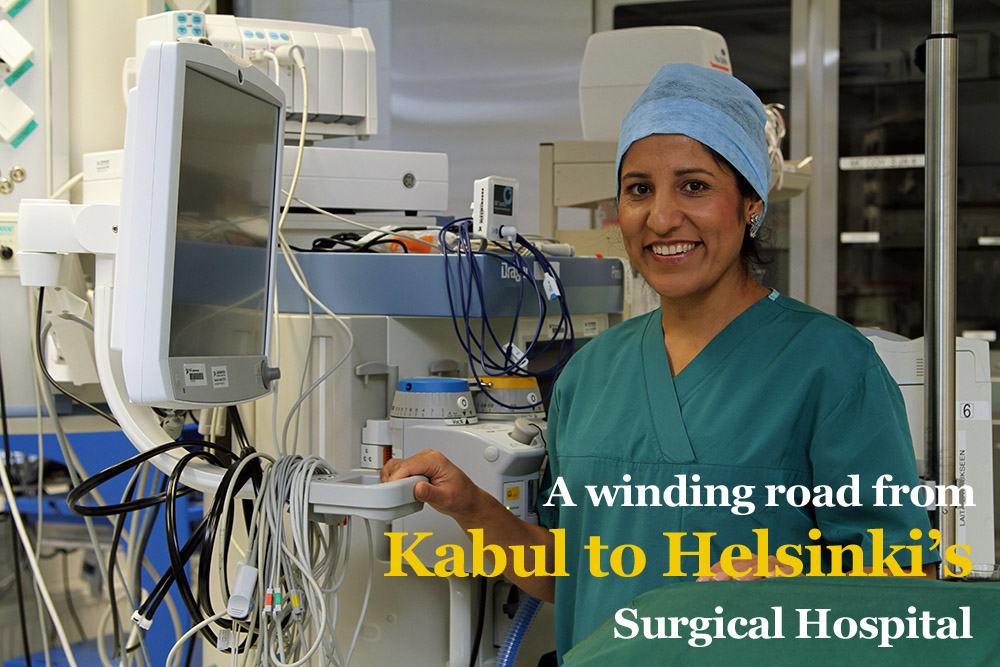
Zarmina Razai’s life changed in a heartbeat when the Taliban executed her father in Kabul in 1998. An unyielding daughter of an entrepreneur, Razai has wanted to show to herself, and to the whole world, that she can cope on her own. She studied in Finland without financial aid and now works as an operating room nurse at the Surgical Hospital in Helsinki.
Zarmina Razai has fond memories from her childhood in the Afghanistan of the 1980’s.
“My childhood was the best. My father’s pharmaceutical firm thrived, and we were wealthy. Everything changed when the Taliban executed my father, like many other businessmen,” Razai recalls.
Razai’s mother had Razai, her 8-year-old younger brother and 19-year-old older brother smuggled out of Afghanistan.
“There was no certainty that we would even survive. I arrived in Finland in 1999. The journey was as nightmarish as my father’s death.”
Razai was placed in a group and family home in Joensuu, where she studied and passed the Finnish matriculation examination in three years.
“I studied the Finnish dictionary and Finnish grammar constantly, even in the bathroom. The local Finnish dialect was a major, additional challenge for me,” Razai says.
A healthy person needs no financial aid
Razai moved to Helsinki in 2003. To make money, she had taken cleaning jobs and picked berries during her school years. She earned an interpreter’s diploma while working for University Pharmacy. Next, she studied nursing and specialized as an operating room nurse.
“I haven’t had any days off, but I’m happy that I have managed. I haven’t taken a day’s worth of student financial aid, because I’m healthy and able to work.”
Razai is very happy at her workplace in the Surgical Hospital in Helsinki, casually known as Kirra, but she dreams about Finnish language studies at the University of Helsinki.
“I would like to teach Finnish to immigrants. They should be offered more opportunities to study the language, and they should be offered apprentice jobs and employment afterwards,” Razai says.
She suggests that recipients of financial aid should compensate for it in one way or another.
“In principle social security is great, but the current system passivates, especially young people.”
Itä-Pasila is better than its reputation
A year after she moved to Helsinki, Razai took a housing loan and bought an apartment in Itä-Pasila (Eastern Pasila).
“With hard work, I have managed to pay off the loan entirely. I have wanted to show to myself, my family and all Finns that I can manage,” she explains.
Razai feels at home in Itä-Pasila. She questions the reputation of Itä-Pasila as a disorderly district.
“Itä-Pasila is an excellent place to live—beautiful and peaceful. The connections by rail are easy, and all services are here.”
Razai also likes southern Helsinki and especially enjoys Punavuori and the vicinity of the Esplanade Park.
“I’m really proud of Helsinki to have been named World Design Capital 2012.”
Razai is a Finnish citizen. She does not plan to move away from Finland.
“I miss Kabul and my relatives in Afghanistan, but what’s in the past is in the past. My life and friends are here now. I even enjoy the Finnish winter, and I love cross-country skiing!”
Razai feels that she is as Finnish as the native Finns. She is hurt by racist comments such as ‘Go back to your country!’
“People need more knowledge about other cultures. It’s all too easy to blame people of immigrant background for problems. Racism could be reduced by discussing things openly.”
Translated by Johanna Lemola
 Helsinki-info on Facebook