
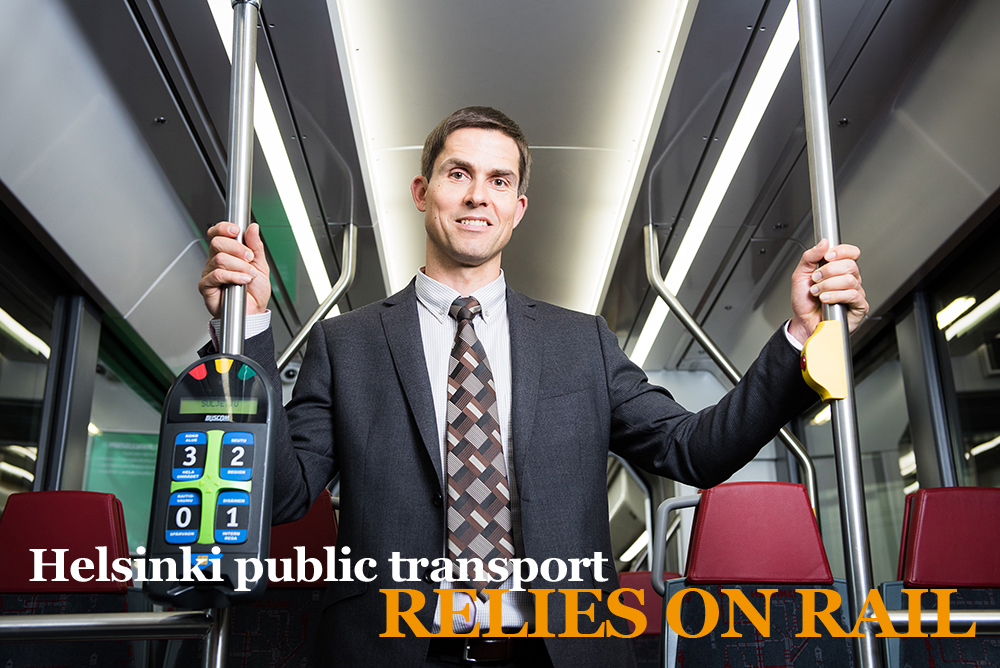
Ville Lehmuskoski has solid experience in public transport.
Before taking the helm at Helsinki City Transport (HKL) in October 2014, he led Helsinki’s traffic and transport planning from 2012.
Prior to that, he led public transport planning at Helsinki Region Transport (HSL), after serving HKL as a director of planning.
Photo Rob Orthen

By Johanna Lemola
Helsinki grows in the inner city supported by a strong public transport rail network.
Helsinki expects vast growth, most of it in the inner city. Over the next two decades, the population and number of jobs in the inner city are expected to grow by half. Ville Lehmuskoski oversees efforts to keep Helsinki moving as the brand new CEO of Helsinki City Transport.
“We can’t put more cars on streets. The answer in the inner city is public transport by rail – trams and the metro,” Lehmuskoski says, pointing out that rail has the biggest capacity of all modes of public transport.
“When Helsinki grows, public transport has to grow with it,” he affirms.
Helsinki residents agree. More than 80 percent of them consider that more effort should be put into the development of public transport; only 17 percent consider that more effort should be put into developing the conditions for driving instead.
Trams meet growing demand
The tram is a strong symbol of Helsinki – and growing stronger.
Helsinki is crisscrossed by a dense network of tram tracks and served by 14 tram lines. Trams are the primary means of public transport in the city centre.
Lehmuskoski explains that the development of Helsinki’s new areas – Kalasatama, Kruunuvuorenranta and Jätkäsaari – relies heavily on trams.
Kalasatama has a metro station at its core, but it will also be served by two trams lines, one of which will run on landmark bridges to be built to connect Kruunuvuorenranta in eastern Helsinki’s Laajasalo to the inner city. The Kruunusillat bridges will be dedicated to trams, as well as cycling and pedestrians. The longest of the bridges will span 1.2 kilometres crossing over a water body. The tram connection via Kalasatama to the city centre will revolutionize life in much of Laajasalo.
Jätkäsaari is already served by two tram lines, 8 and 9. As development moves forward, a third connection will be added to the central part of the district.
In the next ten years, the number of trams in traffic in Helsinki will grow by almost half, from 94 to about 135 to meet the growing demand.
Helsinki’s new tram – the world’s best
The Helsinki tram fleet is about to be boosted by an outstanding new tram. Transtech Artic, manufactured by Transtech in northern Finland, is a showcase of Finnish engineering and design.
“It is my understanding that Artic is the world’s best tram,” Lehmuskoski states.
Forty new Artic trams will arrive in Helsinki in 2015-2018.
The metro extends and goes automatic
The Helsinki metro is being extended to the west with seven new stations, two of them in Helsinki and five in Espoo. “The west metro” is scheduled to go into operation in the autumn of 2016.
The launch of the new service is planned to coincide with automation, meaning that the metro trains will run without drivers. “The west metro can be operated manually, too,” Lehmuskoski assures, dismissing concerns that delays in automation could delay the launch.
“Metro trains have been automated in many cities for years, for example, in Copenhagen,” he continues, calming down those concerned about driver-less trains. He reminds metro passengers of the joy of being able to ride in the cockpit.
Public transport grows in popularity
Year 2012 saw a notable milestone in Helsinki: after a long-term steady decline, there was an upturn in the use of public transport in the Helsinki metropolitan area. In that year, 43 percent of all journeys in the area were made by public transport. “Indicators show that the upward trend will continue,” Lehmuskoski says.
Public transport is the preferred mode of transport in journeys to the city centre: almost three-quarters of the peak hour commuters use public transport.
International studies also show that Helsinki area residents are highly satisfied with public transport services. Over a number of years, the Helsinki metropolitan area has consistently topped the European BEST survey on customer satisfaction in public transport.
Envisioning a city on rail
Helsinki is preparing a new city master plan. The plan will steer land use and the development of the community structure on a long term.
Ville Lehmuskoski explains that the main principle of the plan from Helsinki City Transport’s perspective is a networked city relying on rail.
“Today rail connections radiate from the Helsinki city centre. In the future, the radiating connections will be linked by crosswise rail lines. The first such major project is Raide-Jokeri (Rail Jokeri), a rapid transit connection to be built from eastern Helsinki via northern Helsinki hubs to the main hubs of western Espoo.
“Another important principle of the city master plan is the development of areas that lie on expressways inside Ring Road I. These areas will be developed for housing and jobs, and each of the areas will be served by a high-quality rapid transit line.”
Helsinki City Transport
Helsinki City Transport, HKL for short, is a City of Helsinki-owned municipal enterprise that operates the Helsinki metro and trams. HKL builds, develops and maintains public transport infrastructure in Helsinki.
HKL partners with Helsinki Region Transport (HSL), which plans and organizes the public transport services in the region, makes the contracts for services, and determines the fares.
 Helsinki-info on Facebook