
Mohamed Dsouki
Photo Päivi Arvonen
By Päivi Arvonen
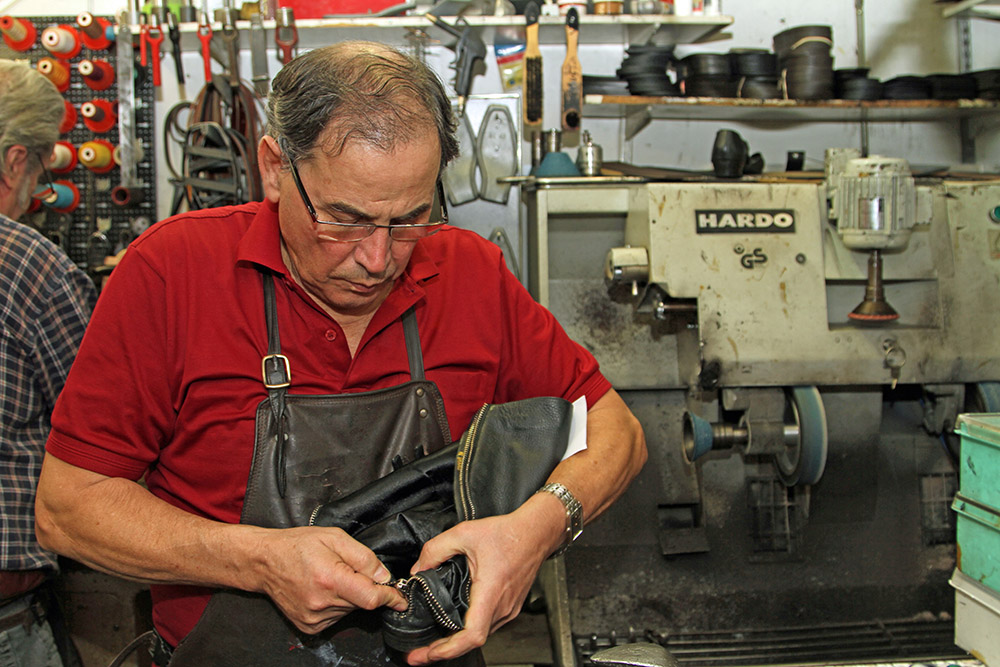
Born in Lebanon, Mohamed Dsouki made Finland his home in the 1970’s. For the past 20 years he has been observing life in the Helsinki city centre from his shoe repair shop at Kaivopiha.
Mohamed Dsouki left his home in Lebanon to work in Germany at age 20. There he met his Finnish wife. The couple moved to Finland in 1974. Multiculturalism was part of normal life in Germany in those days, and his five years in Germany prepared Dsouki to life in Finland and the Finnish culture.
“I came to Finland to stay,” he says. “I have lived two-thirds of my life here. Finland is my home country, and my ties to Lebanon have weakened over the years. I mostly go to Lebanon to attend funerals.”
Finland and Helsinki of the 1970’s were home to few foreigners.
“People were very interested in foreigners in the 1970’s. I still retain friends from those days. But attitudes have changed. For example, people don’t want to sit next to foreigners on public transport these days,” Dsouki says.
According to Dsouki, attitudes towards foreign-born people started to change in the 1980’s and 90’s along with the arrival of the Somalis.
“The media nurtures hostility towards foreigners by reporting only negative aspects,” Dsouki complains.
Many foreigners are forced to self-employment
Dsouki first worked on dockyards in Finland but soon became an entrepreneur, founding a business in 1975.
“My accountant asked me what would be the name of my new business. I wanted a name reflecting the Middle East but one that Finns could remember easily.”
He named his business Alladin. Alladin first sold hand-made leather bags imported from Lebanon. The shop was located in the Heimola building next to the University of Helsinki’s Porthania in the city centre campus. Shoe Repair Alladin opened at Kaivopiha in 1994 and now serves the second generation of customers. In 2002 Dsouki opened a second shoe repair shop in the underground Asematunneli shopping centre.
Now in retirement age, Dsouki still keeps busy at his shops.
“Many of our regular customers want to deal with me personally. I’m happy to serve them for the time being,” Dsouki says.
Dsouki has always enjoyed being self-employed but admits that many foreign-born people in Finland have no other choice than self-employment.
“Immigrants should get jobs. Now self-employment is the only alternative for many, because jobs are hard or impossible to find.”
You can’t understand the culture if you don’t understand the language
Dsouki studied Finnish in the 1970’s both with a personal instructor and by picking it up.
“Satellite TV channels and the Internet offer people a lot of alternatives to bide their time. But they don’t help immigrants to integrate into society and learn the language. Four decades ago you had to learn Finnish. I still read Helsingin Sanomat every day, although I also read news in Arabic on the Internet.”
Dsouki particularly appreciates the cleanliness, safety and democracy in Finland and Helsinki. He thinks that Helsinki is an attractive city especially in summer. His favourite places in summer Helsinki include the Esplanade and the Market Square’s waterfront.
“I have experienced Finnish history through my wife’s parents. They lived through the war, and I appreciate their sacrifices. I always hoist the Finnish flag on the Independence Day.”
Translated by Johanna Lemola
 Helsinki-info on Facebook