
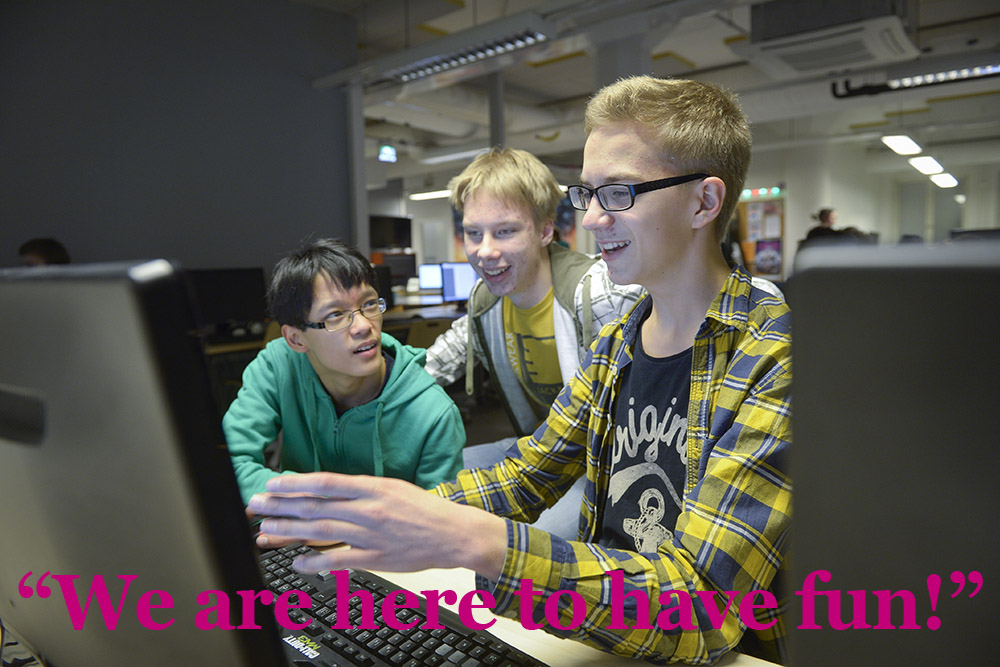
Daniel Riissanen (left), Casper Talvijoki and Onni Kosomaa are high achievers at GameDev Club.
Photo Kimmo Brandt
By Johanna Lemola
Games are a powerful tool for the Helsinki youth work. A game development club turns games into an enjoyable social experience – and a possible stepping stone to the future for some.
A large dot moves on the computer screen in a battle-ship style, shooting and sweeping off the screen smaller dots – the enemies. The battle-ship dot is maneuvered by 16-year-old game developers Casper, Daniel and Onni. When not demonstrating the game, they are busy coding to develop Specular.
Specular is a mobile game that Casper, Daniel and Onni intend to have ready for Google Play within a couple months, to be available for download to Android phones and tablets.
Casper explains that he is the father of Specular’s concept. “Specular is a combination of many games I like to play myself,” he says. Daniel and Otto are coders. All three – classmates on the first grade of lukio (general upper secondary school) – announce that they plan to make game development their careers.
Some 25 other young amateur game developers work in teams at other work stations. At the end of the session, they screen their games to each other. In one game a space alien crashes through a roof into a room and has to put itself into a spot of light to be beamed up back to space. In another game, a miner escapes hot molten lava jumping over ravines, moving to more demanding levels of the game as he goes.
The occasion is the demonstration night at the “GameDev” game development club, and the place is the Game Room at the Helsinki Youth Department’s Happi activity centre.
“We are here to have fun!”
“What’s important for us here at GameDev Club is not the final product but the process of developing games together. Our main goal is to offer young people a meaningful and rewarding activity in a social environment,” explains the club supervisor, Helsinki youth worker Ari Huotari.
“We’re not a business incubator. We’re also not a school or a course on game development,” Ari explains further.
“Any young person age 13–25 is welcome to join, even if they are new to gaming, as long as they have worked on computers before. The supervisors get newcomers started, and the Gamemaker programme guides them on.
“The only requirements for club members are commitment, willingness to learn, and good English to be able to work with Gamemaker.”
The GameDev Club members work in teams of 2–4. They develop a game during 3-hour Monday night sessions over a period of six weeks. The teams create the ideas for their games by themselves, while supervisors may only intervene if an idea seems too ambitious. Team members assume various roles – one can focus on the overall concept, while others specialize in graphics, sound or coding.
Ari says, “The main thing is that the teams communicate, keep working and – importantly – have fun!”
Coached by professional game developers
Each GameDev Club session is attended by one or more professional game developers. They instruct club members and give feedback. One of the professionals is Joonas Laakso, a producer at the highly successful video-games company Remedy Entertainment (known for Max Payne and Alan Wake).
Joonas rarely misses a session. He explains why: “It’s rewarding for me to contribute. When I took my first steps in game development in the 1980’s and 90’s, there was nothing for amateur game developers. I had to learn everything from the Internet by myself.” The 35-year-old game enthusiast’s earliest memories of game development are from a time when he could not even read – he would draw games on a piece of paper.
Noe Falzon, a French programmer at Rovio (known for Angry Birds), joined more recently. Another self-educated game developer, he is impressed by GameDev Club. “This is a fabulous place and opportunity for young people. They learn here twice as fast as we did when we started.”
Game Room advances the digital gaming culture in multiple ways
“Helsinki’s youth work goes where young people are. As a result, gaming is a must for us,” says the Game Room’s producer Hannes Pasanen. He says that 95 percent of the Finnish youth play digital games weekly and 50 percent daily.
Hannes explains the Game Room: “The Game Room is a space where young people can play with friends or find new friends. It is a space where young gamers can enrich their gaming experience by organizing activities, such as gaming tournaments, or they can join activities organized by others. The Game Room is a space for learning.” The staff’s role is mainly to assist and to enable the activities.
The Game Room is equipped with consoles and PC’s that can be freely used by young gamers on Friday and Saturday nights to 11 p.m. Game Room users can propose new games to be added to the Game Room selection.
The Game Room also offers its facilities for various independent actors and groups, such as associations for digital games. They can use the facilities for single events or for regular programmes. “We want to put our space and equipment to the best possible uses,” Hannes affirms. “We can give users guidance as needed.”
The Game Room’s experimentation with games extends to prevention of social exclusion. A group of 15- to 16-year-old boys, who are severely restricted socially, meet at the Game Room once a week to learn social interaction around gaming. Every fourth meeting is devoted to a completely different activity.
The Game Room is a forerunner in Helsinki in using digital gaming to achieve larger goals. Schools follow. The Torpparinmäki comprehensive school offers a class in game development, which is used as a tool to teach other subjects. Other schools organize gaming clubs.
 Helsinki-info on Facebook