
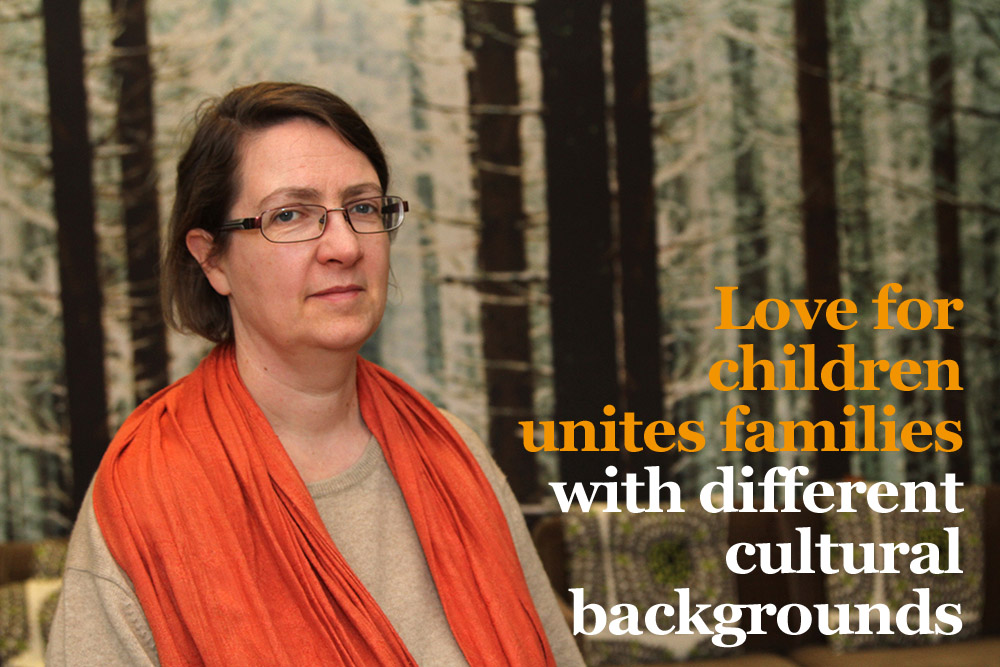
Anita Novitsky
Photo Päivi Arvonen
By Päivi Arvonen
In the global world people of different cultural backgrounds more and more often live together or side by side. Conflicts often arise if people’s knowledge of other cultures is biased by misunderstandings, prejudices and stereotypes.
Differing views about families often collide in Finnish homes today, as the number of first- and second-generation immigrants is on the rise, and more and more Finns live with a spouse or children from another culture.
One of the main tasks of families is to bring up their children as members of society despite their cultural backgrounds.
“All parents love their children and make their upbringing choices accordingly. Depending on the parents’ cultural background, these choices can differ widely,” says Anita Novitsky, an expert in multiculturalism at the Family Federation of Finland (Väestöliitto).
Conflicts are often communication problems
Novitsky has both counselled multicultural families and trained city and other municipal employees who work with multicultural issues. The Family Federation’s centre for multicultural affairs provides consultation free of charge for immigrant families in questions concerning family life.
“Demand far exceeds our customer service resources,” Novitsky says.
She has found that the problems faced by families are often very similar regardless of their cultural backgrounds.
“Many conflicts in families are communication problems. Parents vary highly in their mutual communication skills. Parents should agree on child upbringing principles well before a child is born. Admittedly, parents’ views can differ widely even if they represent the same culture.”
According to Novitsky, parents often lack basic parenting skills.
“What’s important is that spouses are able to support each other, give each other space, trust themselves as parents and respect each other. These aspects are often stumbling blocks in relationships regardless of the spouses’ cultural background.”
Have the courage to ask if you’re concerned
“Finnish authorities often view parenthood from the Finnish perspective. Misunderstandings arise easily if they don’t know the customs of other cultures and people’s backgrounds,” Novitsky says.
Misunderstandings can also arise between neighbours and concerning children’s daycare-centre and school mates.
“For example, the manner of communicating in some culture can be very different from the Finnish way of speaking. Loud speak may sound to a Finn like arguing or shouting, but it may be perfectly normal communication for some,” Novitsy points out.
She encourages everybody – authorities, co-workers, and worried neighbours, mothers and fathers – to ask bravely if they are concerned about something.
“You can always ask what some situation or expression meant, and you can say that you were concerned,” Novitsky says.
Translated by Johanna Lemola
 Helsinki-info on Facebook