Sato’s towers / Architect Lauri Silvennoinen
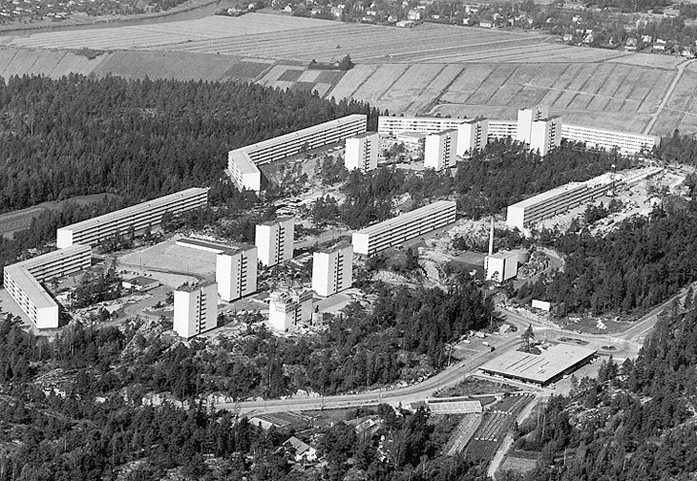
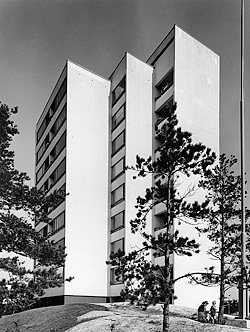
Sato’s towers rise in two 5-building groups above the low apartment blocks to form the urban emblem of Pihlajamäki that can be seen from afar in the landscape. The tower’s plans are asymmetric and oriented in different directions. The stepped facades’ dwelling units open towards the southwest with large landscape windows and balconies, with views towards the centre of Helsinki from the apartments’ uppermost floors. The visual impact of the reduced window openings for kitchen facilities on the northeastern facades is minimalistic but impressive, forming a so-called zipper theme with the stairwells’ windows. The buildings’ original appearance has suffered greatly as a result of facade renovations carried out during the 1970s.
The Sato area’s towers are architectural landmarks that have become icons for the area. Restoring the original architecture’s sculptural quality is one of the major objectives of the protective plan and renovation guidelines.
Sato’s long apartment blocks /
Architect Lauri Silvennoinen
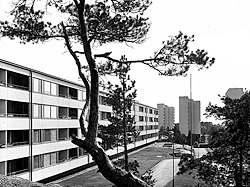
The four over-long apartment blocks form a horizontal wall above which the towers rise. The horizontal lines of the ribbon window facades emphasise the reposeful nature of the overlong buildings. The apartments open to forested surroundings. Efficiently rationalised dwelling plans are used repetitively throughout the complex.
Completely prefabricated element technology was applied for the first time when implementing Sato’s long blocks, whose ascetically elongated ribbon facades are one of the best examples of that period.
Except for Kiillekuja 4, Kiilletie 5 and the northern part of Rapakivenkuja 2, the buildings’ panel facades have retained their original appearance. Painted Siporex and fired brick laid up in-situ were used on the buildings’ end facades.
The new stairwells at Vuolukiventie 11 and Kiillekuja 3 were built in 2001 and 2003 in connection with the installation of new lifts.
White and black Sato area
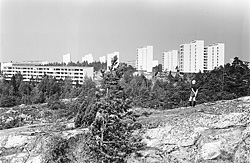
One of the characteristic features of the buildings in the Sato area is the use of black and white colours that emphasises the proportions and the abstract quality of the facades. The colour white had also been one of the hallmarks of Modernism. During the 1960s, exposed concrete surfaces were never used as such, but were usually plastered or stuccoed white. The black-and-white colouring accentuated the contrast between the building and its landscape setting. Thanks to the dark grey plinth, the white buildings seem immaterial and appear to hover above the ground.
Another interesting aspect in the architectural history of Pihlajamäki is the use of photography as a way to express the designers’ intent. Sciagraphy, “the play of light and shadow” through photographic means, was combined to emphasise the minimalistic quality of the architecture. Sato’s towers were photographed as if they were giant sculptures set against the rocky forest landscape. This required the object-like treatment of buildings in relation to their environment – placing them on a pedestal surrounded by plenty of empty space.
Back |