SHOPPING CENTRE |
 |
|||||
 |
||||||
Helsge Heinonen / Haka archives |
||||||
 |
||||||
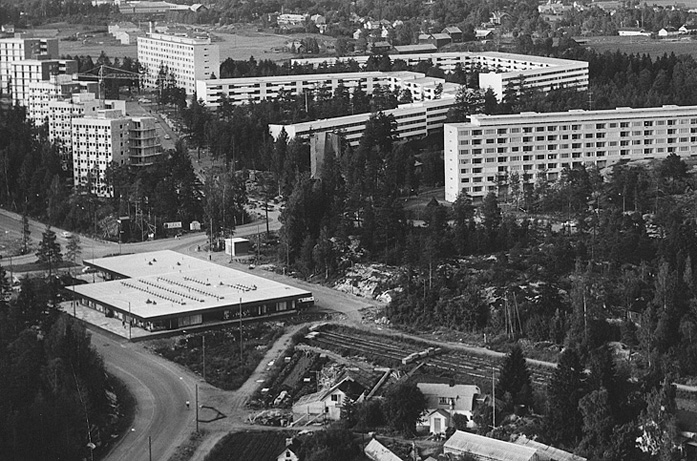
Shopping centre from the southeast, Haka’s area in the background |
||||||
Eero Troberg / Sulo Savolainen archives |
||||||
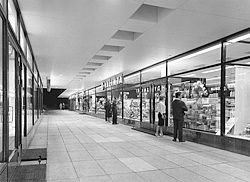
Commercial services in the suburban cell model Already in the 1940s, Professor Otto-Iivari Meurman had outlined the principles for locating suburban shops in his so-called cell model. Providing a proper level of services for a housing suburb required a local shopping centre and neighbourhood services for each dwelling cell. In accordance with the prevailing ideals of that period, commercial services were integrated with Pihlajamäki’s urban fabric. After several phases, the shopping centre found its present central position. Each dwelling cell also had its own local grocery store. By the 1960s, more thought began to be given to dwelling unit sizes and the placement of services in housing areas. An admiration for American rationalism and planning models based on a consumer society led to the reshaping of customers’ buying patterns; traffic considerations dictated the siting and design of shopping centres. The use of the private car – “autoshopping” – permits larger purchases at a time. Following this ideology, the shopping centre was located at the focal point of the suburban housing area’s traffic systems. In terms of their architecture, Helsinki’s suburban shopping centres from this period show similar features: flat-roofed and often enclosing an atrium courtyard to form building groups linked by canopies. Pihlajamäki shopping centre / The shopping centre designed by the architects Kaija and Heikki Siren was completed in 1963. The single storey shopping centre is a elegant and stylish glass box whose wide eaves and large window surfaces represent 1960s suburban shopping centre typology at its purest. The building features a skylit central corridor; at one end a market square area is formed between the original structure and an extension built later. Upon its completion, the building was described as follows: “The glittering glass and copper in the building compete with the surrounding red granite rock outcroppings”. Architect Eino Tuompo designed the shopping centre’s extension that was completed in 1970. Pihlajamäki’s neighbourhood shop buildingsThe neighbourhood shop buildings were completed during the years 1963-65. Taking the commercial premises out of the apartment buildings’ ground floors conformed to the building companies’ wishes and furthered the standardisation of the apartment buildings’ structural frames. Pihlajamäki’s neighbourhood shop buildings, with their flat roofs and stores behind a glass facade, have townscape value with respect to the creation of a more human scale between high-rise apartment buildings. Architect Sulo Savolainen designed the two shop buildings in the Haka area; architect Esko Korhonen designed the northern section’s shop and architect Lauri Silvennoinen designed the two commercial buildings in the Sato area. |
 |
|||||
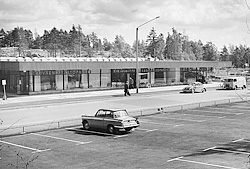
The shopping centre’s broad fascia has been clad in copper; the window surfaces are untaped. |
||||||
Eero Troberg / Sulo Savolainen archives |
||||||
 |
||||||
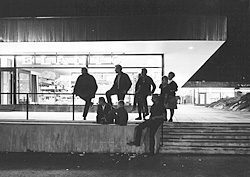
Square at end; lit from below, immaterial roof surface. |
||||||
Eero Troberg / Sulo Savolainen archives |
||||||
 |
||||||
Shopping centre’s central corridor with roof lights. |
||||||
 |
||||||